Update File Attributes - Update files attributes - read only, hidden and more (Updated Oct 2026)
Description
Update File Attributes is a comprehensive tool for bulk editing Windows file attributes and timestamps.
You can add or remove attributes such as Read-only, Hidden, System and Archive, adjust created and modified
dates in several modes, and narrow down exactly which files are affected using attribute, date and size
filters. Presets, quick �touch� actions, command-line export and a context menu integration make it ideal
for repeatable admin tasks, while Dry Run and logging provide a safe way to verify changes before applying
them.
Undo it later
The previous dates and attributes of every file are recorded in the
Change Journal, so you can put them back later — for the whole run or individual files — even after closing the app.
How to use

Source selection
-
Select files or a folder:
In File(s), you can specify one or more individual files (or paste a path using
Paste Path). In Folder, choose a folder whose contents you want to process.
Tick Subfolders to include files from all subdirectories under the selected folder.
-
Filter by name:
In File filter, enter a pattern such as *.* for all files,
*.log for logs, or *.tmp;*.bak (if you support multiple patterns)
to target specific file types only. The Current label shows a brief summary of the
active selection.
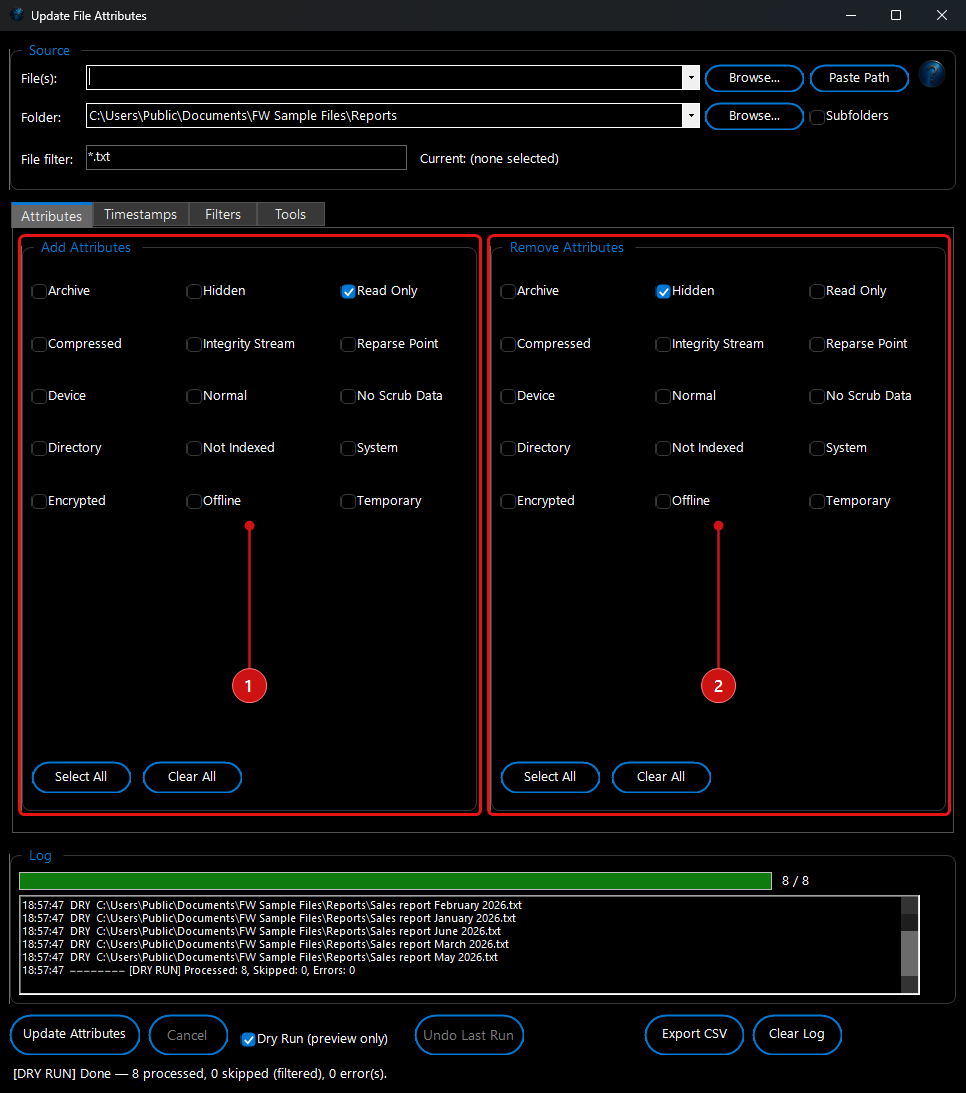
Attributes tab: add and remove attributes
-
Select attributes to add:
In the Add Attributes panel, tick the attributes you want to set on matching files, such as:
Archive, Hidden, Read Only, Compressed, Integrity Stream, Reparse Point, Device, Normal, No Scrub Data,
Directory, Not Indexed, System, Encrypted, Offline or Temporary. Use Select All or
Clear All for quick changes.
-
Select attributes to remove:
In the Remove Attributes panel, tick the attributes you want to clear from matching files.
This allows, for example, removing Read Only or Hidden flags in bulk.

Timestamps tab: created and modified dates
-
Choose a timestamp mode:
Under Mode, pick how timestamps should be updated:
- Absolute Date/Time � set created/modified to a specific date and time.
- Shift Relative � move existing timestamps forward or backward by a chosen offset
(for example plus one day).
- Copy from Reference File � match timestamps from a specific reference file.
- Inherit from Parent Folder � align file timestamps with their parent directory.
-
Update created and/or modified dates:
Tick Update Created and/or Update Modified to enable changes. Then set the target date
and time, or the relative offset depending on the selected mode. Additional controls (such as applying
a full-day offset) help fine-tune behaviour.
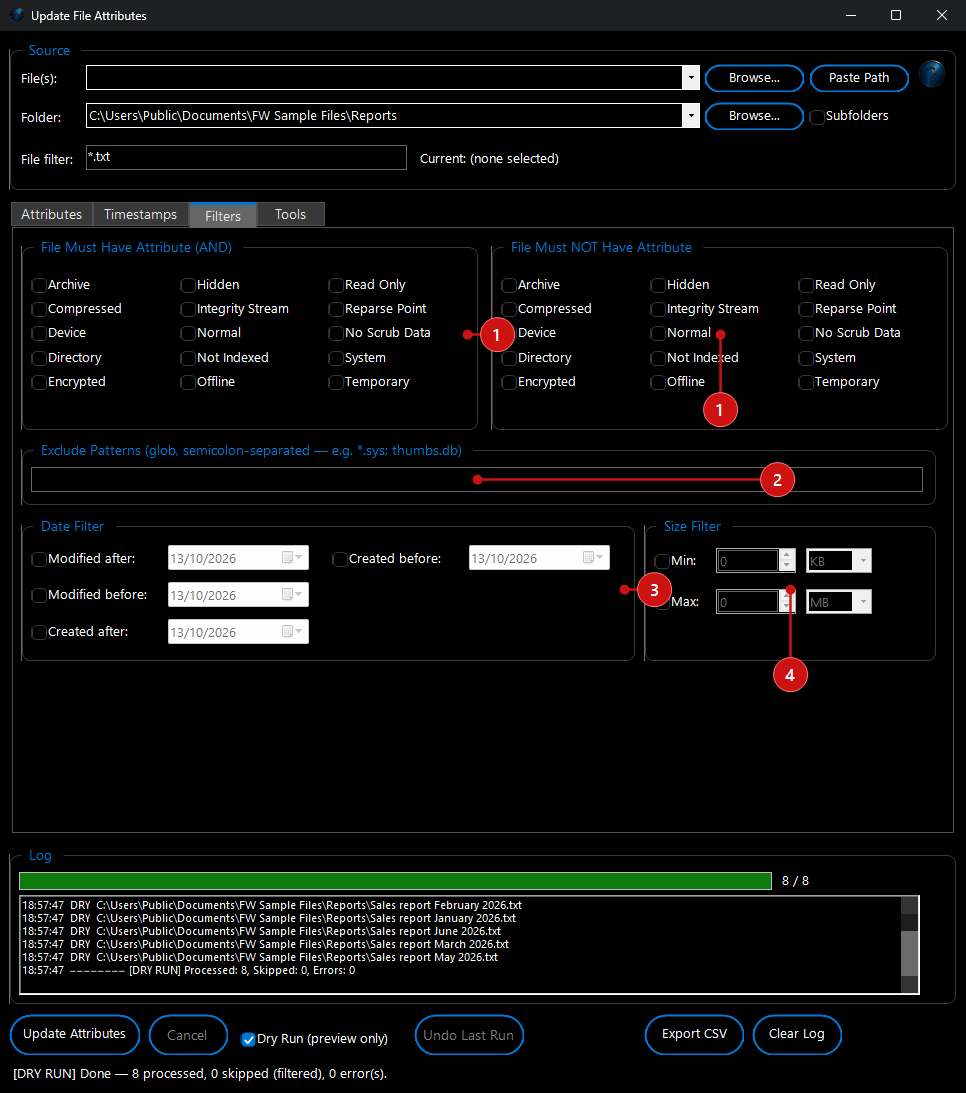
Filters tab: target specific files
-
Filter by existing attributes:
In File Must Have Attribute (AND), tick attributes that files must already have to be included.
In File Must NOT Have Attribute, tick attributes that must be absent. This combination lets you,
for example, only process files that are currently Hidden but not Read Only.
-
Exclude patterns:
Use Exclude Patterns to skip files by name using glob patterns (semicolon-separated), such as
*.sys;thumbs.db.
-
Filter by date:
In the Date Filter section, choose any combination of:
- Modified after / before � include only files whose modified date falls within a range.
- Created after / before � include only files by creation date range.
This is useful when correcting or normalising metadata for specific periods.
-
Filter by size:
In Size Filter, enable Min and/or Max and set sizes with units (for example KB,
MB). Only files within this size range will be processed.
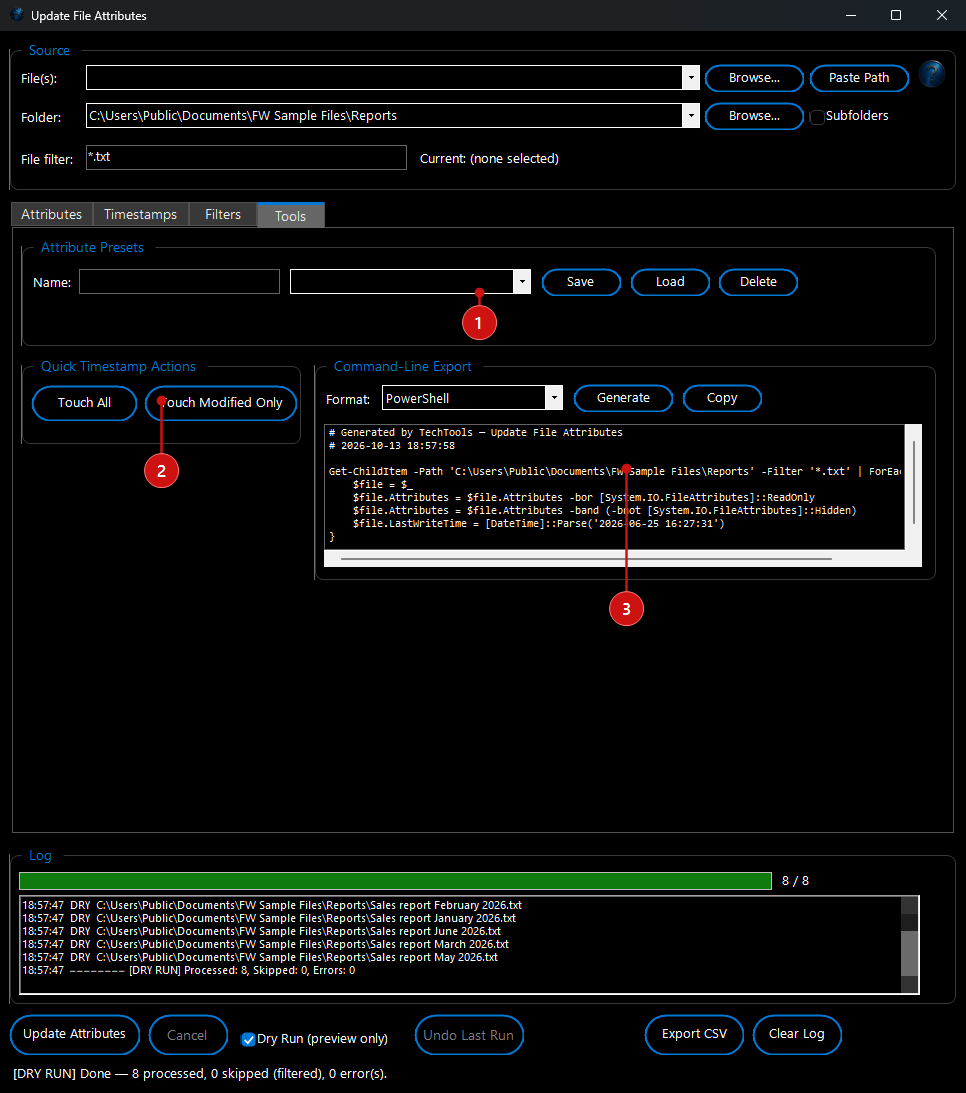
Tools tab: presets, quick actions and scripts
-
Attribute presets: Use the Name field to save, load and delete attribute/timestamp
configurations. This is ideal for recurring tasks such as preparing archive sets or normalising imported
data.
-
Quick timestamp actions: Touch All and Touch Modified provide quick
ways to update timestamps to the current time without building a full configuration.
-
Command-line export: Choose a Format (for example PowerShell), click
Generate to create script commands that replicate your current settings, then Copy
to paste them into your own scripts or automation tools.
-
File Explorer right-click menu: Right-click files or a folder in File Explorer and choose
FW Tech Tools > Change dates and attributes to open this tool with them already selected.
You can turn the menu on or off in Options > Tools.
Running and reviewing operations
-
Dry Run (preview only): Enable Dry Run to simulate attribute and timestamp
changes without modifying any files. This is strongly recommended when first applying new filters or
presets, especially on production or client systems.
-
Update Attributes: When ready, click Update Attributes. Progress and results
appear in the Log panel, showing which files were updated and any errors.
-
Export and clear log: Use Export CSV to save a structured log for auditing or
reporting, and Clear Log to reset the display for the next run.
Run it automatically with Watch and Process
Have the settings and dates of every file that arrives in a folder changed automatically — for example make each file read-only so it can't be changed by mistake, or give each photo the date it was taken — without opening this window.
How to set it up:
1. Open
Watch and Process Automation, type a
Task Name and pick the
Watch Folder with
Browse… — the folder your files arrive in.
2. In
File Types type the files to change, for example
*.pdf,
*.jpg, *.heic or
*.*.
3. Click
Add FW Tool…, choose
Update File Attributes, and set
Read-only,
Hidden,
Archive and
Not indexed to
Turn it on,
Turn it off or
Leave it as it is. Under
Dates choose to leave them, set them to
the date the photo was taken, to
now, or to a date you type (for example 2026-10-27 09:00), and tick which dates to change (
Created,
Modified). The line
What this step will do at the bottom of the window sums up your choices. Click
OK.
4. Click
Add Task, select the task and click
Start Watching. From now on every new file is handled within a few seconds, while the Watch and Process window is open (it can be minimised).
Example: Photos copied from an old camera or a messaging app often show the date you copied them, so they sort in the wrong order. A task watching
Pictures\To Fix with
Dates set to
the date the photo was taken gives
IMG_0315.jpg (taken on 15 March 2024) the Created and Modified date 15 March 2024 10:20, so it sorts with the other photos from that day. Or watch
Documents\Signed and turn
Read-only on, so signed contracts can't be changed by accident.
Good to know: "Date taken" only works for photos that have it stored inside them; other files are skipped with a message. A read-only file can still be moved, but
Delete After Processing can't delete it — don't combine the two. Hidden files stay hidden in File Explorer unless you choose View > Show > Hidden items. Type dates as year-month-day (2026-03-04 means 4 March) so there's no mix-up between days and months.