Backup Files - backup files/folders with a single click (Updated Oct 2026)
Description
Backup Files is a Windows backup utility that helps you copy important files and folders to another location using saved backup jobs. It is designed for quick one-click backups, simple job management, and flexible overwrite options — and now goes further, letting you run every job in one click, verify that your backups actually match the source, estimate how much space a backup will need before you run it, and move your whole job list between computers with export and import.
Key Features
Easy Job Creation: Quickly set up new backup tasks by defining what you want to back up and where you want to save it. A job counter above the list always shows how many jobs are configured.
Flexible Backup Modes: Choose from several options to manage how your backups are handled:
- Create full new copies: Saves a complete copy in a new dated folder each time, so earlier copies are kept.
- Don't Override if it exists: Preserves existing files at the destination.
- Override if newer: Updates files only if the source file is more recent.
- Always Override: Replaces existing files regardless of age.
One-Click Execution: Run a single job, or click 'Run All Backups' to run every configured job in sequence — with a live status line showing progress and a summary of how many succeeded when it finishes.
Backup Verification: 'Verify Backups' spot-checks your destination against the source — comparing file existence, size and modified date — and produces a report of matched, missing and mismatched files, so you know your backups are good before you need them.
Size Estimates: 'Estimate Sizes' scans each job's source folder and reports the file count and total size per job, plus a grand total, so you can check the destination drive has room before running.
Export & Import: Save your entire job list to a single file and import it again on another computer or after a rebuild — imports are validated, and duplicates or missing folders are skipped and reported.
Run History & Logs: Hover over any backup job to see when it last ran, and click 'View Log Files' to open the folder containing the log of every backup run.
Unlimited Backup Jobs: Create as many backup configurations as you need, offering comprehensive coverage for all your data.
Simple Job Management: Easily remove unwanted backup jobs by marking them for deletion upon closing the application — the job counter shows how many are pending removal.
How to use
1. Click '+ Add Backup Job' to add a backup job.
 2.
Browse and locate the location you want to backup.
3. Browse and locate the location you want to save the backup.
 4.
Select what type of backup you would like to use. Options are:
- Create full new copies (a new dated folder each run)
- Don't Override if it exists
- Override if newer
- Always Override
 5.
Click 'Save All Jobs' to save your backup jobs before running them. Jobs are also saved automatically when you close the tool.
 6.
Run your backups. Click 'Backup Now' on an individual job, or click 'Run All Backups' to run every configured job one after the other. The status bar shows which job is running and, when everything finishes, a summary with the start and finish times and how many jobs succeeded. Repeat steps 1 to 6 to setup more backup jobs — there is no limit on how many backup jobs you can create. Hover over any job to see when it was last run.
 7.
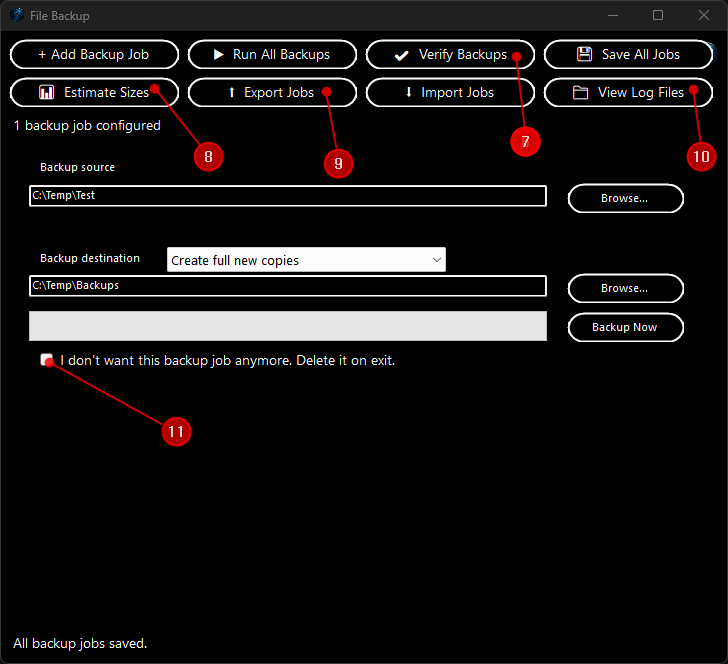
Check your backups are good with 'Verify Backups'. The tool spot-checks the files in each destination against the source — comparing that each file exists and that its size and modified date match — and shows a verification report listing matched files, files missing from the destination, and any size/date mismatches. For very large jobs it samples up to 500 files so the check stays fast.
8. Before running a big backup, click 'Estimate Sizes' to scan the source folder of every job. You'll get a breakdown per job of how many files it contains and their total size, plus a grand total — handy for checking there's enough room on the destination drive.
9. Take your jobs with you. 'Export Jobs' saves your entire backup job list to a single file, and 'Import Jobs' loads a previously exported file — perfect for setting up a new computer or restoring your configuration after a rebuild. Imports are checked as they load: entries with missing folders, bad formatting or duplicates of jobs you already have are skipped and reported.
10. Click 'View Log Files' at any time to open the folder containing the log files from your backup runs, so you can review exactly what was copied and when.
11. If you no longer need or want a backup job, tick 'I don't want this backup job anymore. Delete it on exit'. The job counter will show it as pending removal, and when you close Backup Files the job(s) will be removed.